
.
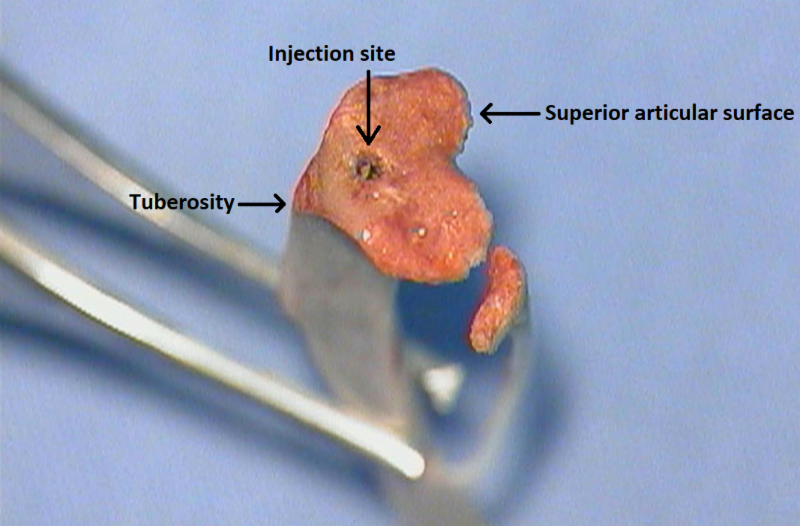
Injection site
What is the Osteomyelitis Rat Model
Our Osteomyelitis Rat Model is unique in that it is non-surgical in its approach. We use female Sprague Dawley rats weighing 200-225 g. Animals are anesthetized with isoflourance (induced at 5% in an induction chamber and maintained at 1-2% on a nose cone) the animals (right leg) is manipulated to form a 90-degree angle with the tibia and femur. Alcohol is used to saturate the skin over the knee and tibia. The hair is wiped down to create a part along the anterior crest of the tibia, which is visualized through the skin by the prominent white coloring.
The inoculation is made on the anterior surface of the tibia. This area is located by running a ½ inch 27gauge needle against the skin, along the anterior crest of the tibia. The needle will slip over the tip of the tuberosity, which is located between the medial and lateral condyles. A rough depression can be felt with the tip of the needle. The patella tendon (silver in color) connects at this point and helps with proper inoculation placement. Once identified, using slight pressure and rotating motion, the needle is pushed into the metaphysic.
The needle is removed and replaced with the new one, which is attached to a Hamilton syringe. 30 ul of bacteria is inoculated into the bone marrow cavity. The needle is removed and the animal is allowed to recover. Inoculation time from induction of anesthesia to full consciousness is <1 minute.
This method was developed in 2004 and it replaced the older model with great success by eliminating the entire surgical procedure with a simple injection. It is safer for the animal, and the risk of a secondary infection is eliminated.
What does the therapeutic approach look like in the Osteomyelitis Rat Model
Once the infection has had time to colonize over a 4-week period, dosing can start. A typical study includes one group of animals that have the infected tibia harvested on day 28 for a negative control. There will also be a group harvested on day 35, 42 and day 49. These time points are flexible depending on the therapeutic approach with the test material. Test groups are harvested at the same timepoints. The route of administration can be oral, IP, IV or subcutaneous. Vancomycin, Cipro and Linezolid are common marketed comparators.
Data Collection for the Osteomyelitis Rat Model
The tibias from the rats are harvested using sterile technique by exposing the tibia and carefully excising the muscle tissue away from the bone. The tibias are crushed with bone rongeurs and placed into a bead beater tube with stainless steel beads. They are homogenized for 2 minutes, and then serial dilutions are made using a 96 well plate. This model has been validated to colonize out to 12 months.
What is Osteomyelitis
Osteomyelitis is an infection of the bone caused by numerous pathogens such as S. aureus and Enterococcus. You may see this due to compound fractures, surgical procedures, prosthetic devices and in diabetic ulcer patients. It can cause significant morbidity, pain and loss of mobility. Drug penetration into bone is poor in general and even more so in elderly patients. Often times, the infection requires debridement of the bone tissue and long-term therapy to eradicate.