Abdominal Model
Peritonitis Model
A defined challenge delivered directly into the peritoneal cavity, measuring a test article’s effect on organism burden and survival.
Peritonitis is inflammation of the peritoneum, the membrane lining the abdominal cavity and covering its organs. It arises most often when bacteria or fungi gain access to a space that is normally sterile, through intestinal perforation, surgical complication, abdominal trauma, or failure of a peritoneal dialysis catheter. Without treatment it progresses rapidly to sepsis, and even with appropriate therapy mortality in severe cases remains high.
TransPharm Preclinical Solutions’s peritonitis model delivers a defined challenge directly into the peritoneal cavity and measures how far a test article lowers organism burden and whether it changes survival.
Research Applications
This model is appropriate when the question is whether a candidate reduces burden in an intra-abdominal infection or improves survival after peritoneal challenge. The intraperitoneal route delivers organisms into a large, highly vascularized cavity, creating a rapidly disseminating infection well suited to agents that achieve broad tissue distribution.
Gastric mucin is frequently used in the inoculum to transiently protect organisms from host phagocytosis immediately after injection, which ensures reliable infection establishment at lower inoculum sizes.
Typical uses include:
- Efficacy screening against a defined challenge strain.
- Comparison against standard-of-care comparators on the same challenge.
- Dose-ranging to establish the exposure–response relationship.
- Activity against resistant isolates, including NDM-1-producing Klebsiella pneumoniae, MRSA, and vancomycin-resistant Enterococcus.
- Polymicrobial challenges, where the intraperitoneal space is seeded with multiple organisms to reproduce the mixed-flora infection that characterizes clinical peritonitis following gut perforation.
Peritonitis sits between the organ-specific models and the advanced sepsis models at TransPharm Preclinical Solutions. Where the interest is a true polymicrobial intra-abdominal sepsis that captures the host response as well as infection control, the cecal ligation and puncture (CLP) model is also available.
Scientific Scope
TransPharm Preclinical Solutions has validated the peritonitis model across the following pathogens:
Gram-Negative Bacteria
- Acinetobacter baumannii – ATCC 17961
- Escherichia coli – ATCC 25404, ATCC BAA-2469, Vogel
- Klebsiella pneumoniae – ATCC BAA-2146
- Neisseria meningitidis – ATCC BAA-335
- Pseudomonas aeruginosa – ATCC 15692 (PAO1), ATCC 27853, ATCC 33347
Gram-Positive Bacteria
- Enterococcus faecalis – ATCC 700802, 03A1065
- Enterococcus faecium – 03B1022
- Staphylococcus aureus – ATCC 13709, ATCC 33592, ATCC BAA-1707 (USA400/MW2), UC-76-rp, USA300, 01A1095
- Staphylococcus epidermidis – ATCC 9491
Fungi
- Candida albicans – SC5314 (ATCC MYA-2876)
Additional validations are available on request, and client-supplied isolates can be characterized and validated in the model before a study begins.
The peritonitis model carries the same add-on measurements available across all in vivo work at TransPharm Preclinical Solutions: pharmacokinetic profiling and PK/PD analysis, blood chemistry, additional tissue harvests, and histopathology, each available on request. All studies run in an AAALAC-accredited facility.
Study Design
Procedure
Animals are challenged with the selected pathogen by intraperitoneal (IP) injection. Gastric mucin is frequently included in the inoculum to protect organisms from immediate phagocytic clearance and ensure reliable infection establishment. Studies are run in both mice and rats. Every study parameter is configurable to the scientific question: challenge organism, host species and strain, comparator agents, and dosing schedule.
Routes of Administration
Test article may be administered by oral gavage (PO), or by subcutaneous (SC), intravenous (IV), or intraperitoneal (IP) injection, so dosing can match the route the program intends to use clinically.
Endpoints
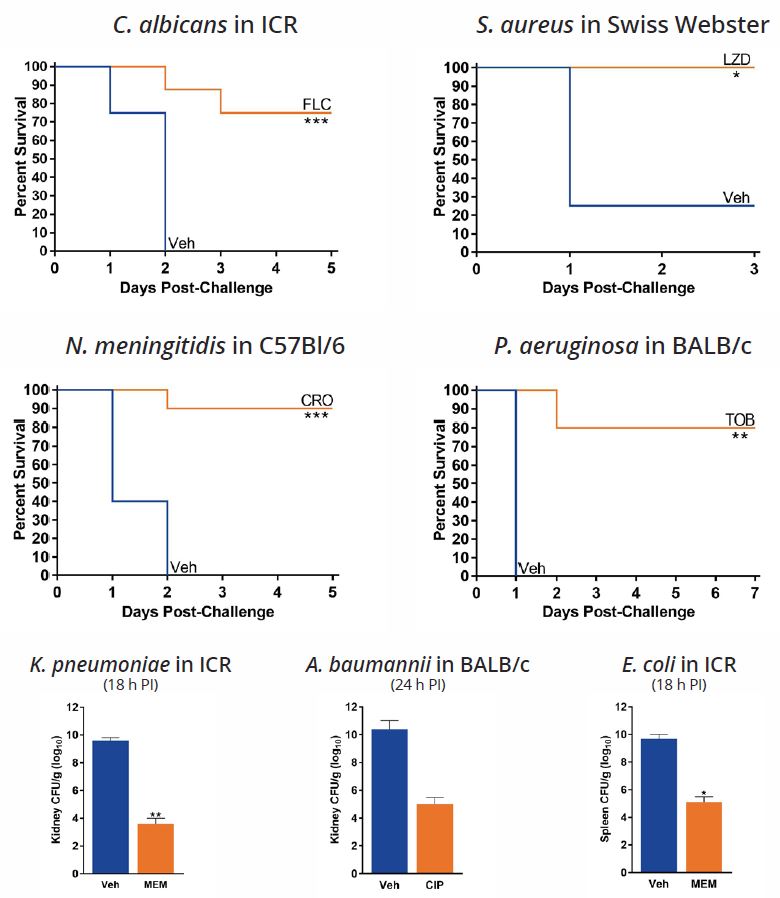
The primary readouts are survival (mortality tracking) and CFU burden in harvested organs and/or blood. Pharmacokinetic profiling, blood chemistry, additional tissue harvests, and histology can be added to any study on request.
Sample Data