Respiratory Model
Pulmonary Infection Model
Acute and chronic lung infection models for evaluating antimicrobial activity against respiratory pathogens in vivo.
The lung is where the largest share of serious infectious disease burden sits. Community-acquired pneumonia remains among the leading infectious causes of death worldwide; hospital-acquired and ventilator-associated pneumonia are among the most common and most lethal healthcare-associated infections; and the organisms responsible include several of the pathogens for which the treatment options are narrowest. For programs in invasive fungal disease, the lung is also the portal of entry and the primary site of disease.
That makes pulmonary efficacy data a gating requirement across a wide range of anti-infective development, and it makes the lung a demanding compartment to treat. A candidate has to reach infected, often consolidated tissue at sufficient concentration, whether it arrives by the bloodstream or through the airway.
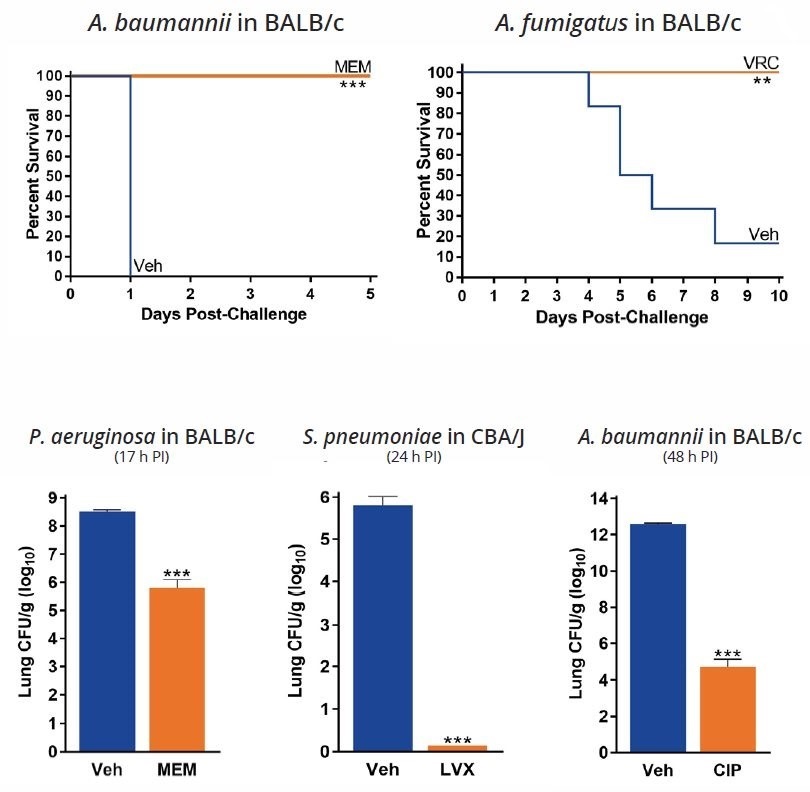
TransPharm Preclinical Solutions’s pulmonary model establishes infection directly in the airway and measures how far a test article lowers organism burden in the lung and whether it changes survival.
Research Applications
This model is appropriate when the question is whether a candidate reduces pulmonary burden, improves survival after airway challenge, or reaches infected lung tissue in useful concentrations.
Three features distinguish it from the other models at TransPharm Preclinical Solutions.
It is validated in both mice and rats. Most models here are established in one species, with the second available on request; the pulmonary model runs in both as standard, which matters for programs that need a second species for regulatory purposes or a larger animal for repeat sampling and PK work.
It supports inhaled delivery. Test article can be given by nebulization or by intranasal or intratracheal instillation as well as by four systemic routes. For inhaled antibiotic and antifungal programs – a substantial category in cystic fibrosis, bronchiectasis, and ventilator-associated pneumonia – the model can deliver the candidate by the route it is actually intended to use, and compare it against systemic dosing of the same compound.
Typical uses include efficacy screening against a defined challenge strain; comparison against standard-of-care on the same challenge; dose-ranging to relate exposure to burden reduction; and activity against resistant isolates, where the comparator is expected to underperform.
Scientific Scope
TransPharm Preclinical Solutions has validated the pulmonary model across the following pathogens:
- Acinetobacter baumannii – ATCC 17961
- Aspergillus fumigatus – ATCC 13073
- Cryptococcus neoformans – ATCC 24067
- Haemophilus influenzae – 54A1218, non-typeable
- Klebsiella pneumoniae – ATCC 43816
- Pseudomonas aeruginosa – ATCC 15692 (PAO1), ATCC 27853
- Staphylococcus aureus (MRSA) – ATCC 33591, ATCC BAA-1556 (FPR3757/USA300)
- Streptococcus pneumoniae – ATCC 10813, ATCC 700674, D39 (serotype 2)
The roster covers organisms at the top of the global priority lists. Carbapenem-resistant A. baumannii and P. aeruginosa sit in the critical and high tiers of the WHO 2024 Bacterial Priority Pathogens List, as do carbapenem- and third-generation-cephalosporin-resistant Enterobacterales, MRSA, and macrolide-resistant S. pneumoniae; H. influenzae appears in the medium tier. A. fumigatus and C. neoformans are both in the critical group of the WHO fungal priority pathogens list.
Several isolates are worth noting individually. ATCC 15692 is PAO1, the sequenced reference strain for P. aeruginosa, while ATCC 27853 is the blood-culture isolate used as a susceptibility-testing quality control strain across commercial MIC systems – so a program can run its in vivo challenge in the same isolate it uses for MIC quality control. ATCC BAA-1556 is S. aureus FPR3757, a whole-genome-sequenced, PVL-positive USA300 isolate from a clinical abscess; it is listed on the live page as both BAA-1556 and USA300 separately, which appears to be the same strain entered twice — pending client confirmation of whether a second, distinct USA300 isolate is also maintained. 54A1218 is a non-typeable H. influenzae isolate, which is the clinically representative form of that organism now that conjugate vaccination has made invasive type b disease rare.
Additional validations are available on request, and client-supplied isolates can be characterized and validated in the model before a study begins.
The pulmonary model carries the same add-on measurements available across all in vivo work at TransPharm Preclinical Solutions: pharmacokinetic profiling and PK/PD analysis, blood chemistry, additional tissue harvests, and histopathology, each available on request. All studies run in an AAALAC-accredited facility.
Study Design
Procedure
Animals are challenged with the selected pathogen by intranasal (IN) or intratracheal (IT) instillation. Studies are run in both mice and rats. Every study parameter is configurable to the scientific question: challenge strain, host species and strain, comparator agents, and dosing schedule.
Routes of Administration
Test article may be administered by nebulization, oral gavage (PO), intranasal (IN) or intratracheal (IT) instillation, or by intravenous (IV), intraperitoneal (IP), intramuscular (IM), or subcutaneous (SC) injection – the widest set of dosing routes available across the platform, and the reason the model suits inhaled candidates as readily as systemic ones.
Endpoints
The primary readouts are survival (mortality tracking) and CFU burden in harvested organs and/or blood. Lung burden gives a quantitative, log-scale measure of treatment effect at the site of infection, while burden in other organs shows whether the candidate has also limited dissemination. Pharmacokinetic profiling, blood chemistry, additional tissue harvests, and histology can be added to any study on request.
Sample Data