Urinary Model
Urinary Tract Infection Model
Ascending urinary tract infection models evaluating activity against uropathogens.
Urinary tract infection is among the most common bacterial infections, affecting an estimated 150 million people worldwide each year. The vast majority of uncomplicated cases are caused by Escherichia coli ascending from the periurethral flora into the bladder, and most are readily treated with a short antibiotic course. The problem is resistance and recurrence. Fluoroquinolone resistance among uropathogenic E. coli is now widespread, ESBL-producing strains have sharply narrowed the oral treatment options for community-acquired UTI, and catheter-associated UTI caused by carbapenem-resistant organisms represents one of the most difficult management problems in the hospital setting.
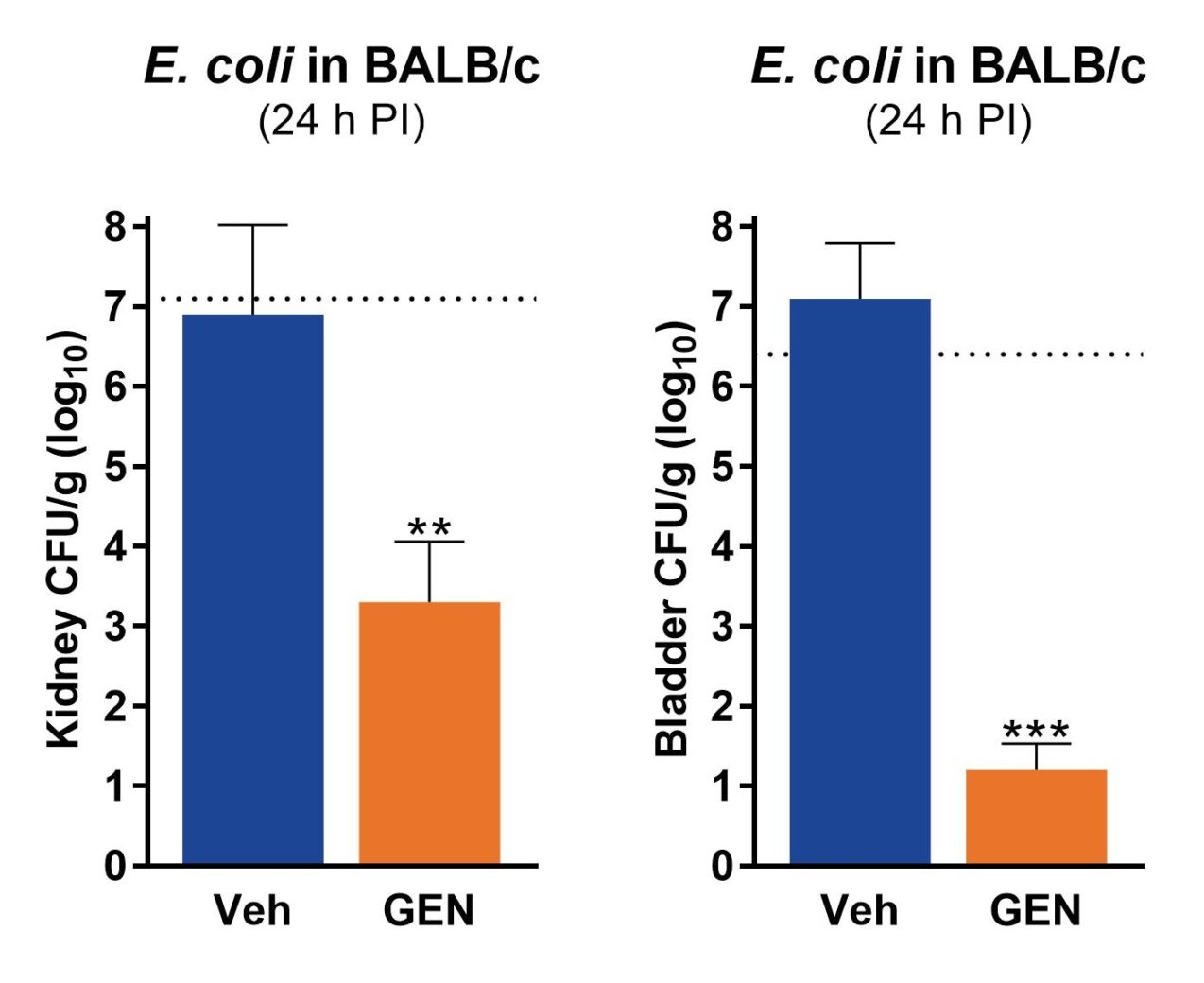
TransPharm Preclinical Solutions’s UTI model establishes an ascending infection directly in the urinary tract via intraurethral challenge and measures how far a test article reduces organism burden in the bladder and kidneys.
Research Applications
This model is appropriate when the question is whether a candidate reduces bacterial burden at the urinary tract infection site. The intraurethral challenge route mimics the natural ascending route of infection rather than delivering organisms systemically, which means the readout reflects drug activity against infection established at the target anatomical site.
The model’s distinguishing feature within the platform is the intraurethral dosing route for test article. Most anti-infective models support oral and parenteral routes only. Here, test article can also be delivered directly into the bladder, which makes this the right model for intravesical and local delivery programs — bacteriophage preparations, antimicrobial peptides, bacteriocins, and catheter coating or lock solutions — where the exposure that matters is at the mucosal surface rather than in plasma.
It suits several development questions:
- Systemic antibacterials for uncomplicated or complicated UTI, dosed by the oral or parenteral route the program intends to use clinically.
- Intravesical or intraurethral formulations, where local drug delivery is the mechanism and systemic exposure is either limited by design or beside the point.
- Activity against resistant uropathogens, including ESBL-producing E. coli and carbapenem-resistant K. pneumoniae.
- Catheter-associated UTI programs, where P. aeruginosa and carbapenemase-producing Enterobacterales are the organisms of greatest concern.
Scientific Scope
TransPharm Preclinical Solutions has validated the UTI model across the organisms most commonly implicated in clinical urinary tract infection:
- Escherichia coli – CFT073 (ATCC 700928)
- Klebsiella pneumoniae – ATCC BAA-2146
- Pseudomonas aeruginosa – ATCC 15692 (PAO1), ATCC 27853
The isolates are well-chosen against the clinical burden. CFT073 is the uropathogenic E. coli (UPEC) reference strain, isolated from the blood and urine of a woman with acute pyelonephritis in Baltimore, Maryland. Its complete genome is sequenced, it expresses the type 1 and P fimbriae central to bladder and kidney colonization, and it is the standard challenge organism in published UTI efficacy studies — which means results generated against it can be set against a substantial body of published work. ATCC BAA-2146 is an NDM-1-producing, KPC-negative K. pneumoniae, the organism most relevant to the carbapenem-resistant catheter-associated UTI setting.
Additional validations are available on request, and client-supplied isolates can be characterized and validated in the model before a study begins.
The UTI model carries the same add-on measurements available across all in vivo work at TransPharm Preclinical Solutions: pharmacokinetic profiling and PK/PD analysis, blood chemistry, additional tissue harvests, and histopathology, each available on request. Urine drug concentrations can be measured alongside tissue PK, which is directly relevant to the urinary tract as both the infection site and the excretion compartment for many antibiotics. All studies run in an AAALAC-accredited preclinical efficacy testing laboratory.
Study Design
Procedure
Animals are challenged with the selected pathogen by intraurethral injection, establishing an ascending infection that colonizes the bladder and, at higher inocula, ascends to the kidneys. Studies are run in mice. Every study parameter is configurable to the scientific question: challenge organism, host strain, comparator agents, and dosing schedule.
Routes of Administration
Test article may be administered by intraurethral instillation, oral gavage (PO), subcutaneous (SC), intraperitoneal (IP), or intravenous (IV) injection. The intraurethral route is available for both challenge and treatment, making this the only model at TransPharm Preclinical Solutions configured for intravesical drug delivery.
Endpoints
The primary readout is CFU burden in harvested organs and/or blood. Bladder and kidney burden are the standard sites for ascending UTI, giving separate readouts for lower-tract and upper-tract infection. Pharmacokinetic profiling — including urine drug concentrations — blood chemistry, additional tissue harvests, and histology can be added to any study on request.
Sample Data