Parasitic Model
Chagas Disease Model
In vivo models for Trypanosoma cruzi and antiparasitic compound evaluation.
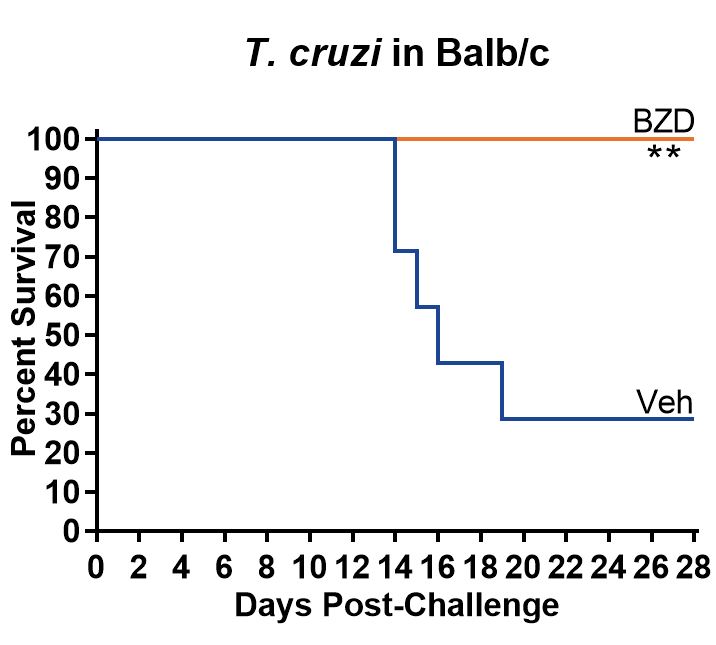
The Chagas disease model reproduces Trypanosoma cruzi infection in mice and produces the parasitological data a trypanocidal program needs: parasitemia over the course of infection, parasite burden in target tissues, and survival.
Chagas disease affects an estimated eight million people, overwhelmingly in Latin America, and the case for new therapy rests on the limits of existing options rather than on resistance. Only benznidazole and nifurtimox are approved, both are decades old, both require long and poorly tolerated courses, and both perform far better in acute infection than against the established chronic disease that causes most of the harm. Background on the parasite, its transmission, and the treatment gap is covered on the Trypanosoma cruzi pathogen page.
Research Applications
This model is appropriate when a candidate has established in vitro trypanocidal activity and the question is whether that activity holds in an infected animal. It suits several development questions:
- Efficacy screening of novel trypanocidal candidates against a defined challenge strain
- Comparison against benznidazole or nifurtimox on the same challenge
- Dose-ranging to relate exposure to parasite suppression
- Combination regimens, which alongside shorter and intermittent benznidazole dosing are among the leading strategies for improving on current therapy
Several compounds, including the azoles posaconazole and ravuconazole, cleared parasites in acute models and then failed against chronic infection in the clinic. A study that demonstrates transient parasite suppression is making a materially weaker claim than one designed around durable clearance, and study design should be set with that distinction in mind from the outset rather than resolved at analysis.
Scientific Scope
TransPharm Preclinical Solutions has validated the Chagas disease model with the Tulahuen strain of T. cruzi.
- cruzi is genetically diverse, divided into seven discrete typing units (TcI–TcVI plus TcBat) that differ in drug sensitivity. Tulahuen belongs to TcVI and is a standard strain in Chagas drug discovery, appearing widely in the published screening literature – often as a derivative transfected with the Escherichia coli β-galactosidase gene, which allows parasite burden to be read colorimetrically. Its prevalence means results generated against it can be set against a substantial body of prior work.
TransPharm Preclinical Solutions maintains an on-site library of hundreds of validated pathogens and can source or validate characterized T. cruzi strains to a program’s specifications.
The Chagas disease model carries the same add-on measurements available across all in vivo work at TransPharm Preclinical Solutions: pharmacokinetic profiling and PK/PD analysis, blood chemistry, additional tissue harvests, and histopathology, each available on request. All studies run in an AAALAC-accredited facility.
Study Design
Procedure
Animals are challenged with T. cruzi by intraperitoneal (IP) injection. Studies are run in mice. Every study parameter is configurable to the scientific question: challenge strain, host strain, comparator agents, and dosing schedule.
Routes of Administration
Test article may be administered by oral gavage (PO), or by subcutaneous (SC), intravenous (IV), or intraperitoneal (IP) injection. Oral dosing is the most frequently requested route here, since both existing drugs are oral and a candidate intended to displace them will need to work by the same route.
Endpoints
The readouts are parasitological. Blood parasitemia is followed over the course of infection, and parasite burden is measured in harvested tissues, alongside survival. Benznidazole or nifurtimox are available as reference comparators.
Measuring both blood and tissue burden matters more here than the equivalent choice in a bacterial model. T. cruzi circulates as the non-dividing trypomastigote but replicates as the intracellular amastigote in host tissue, particularly cardiac and digestive muscle, and it is the intracellular form that drives chronic disease. A compound can suppress circulating parasites while leaving the tissue reservoir intact, and only the tissue measurement distinguishes those outcomes.
Pharmacokinetic profiling, blood chemistry, additional tissue harvests, and histopathology can be added to any study on request. Histopathology is worth considering in this model specifically, since tissue parasitism and the associated inflammatory response in cardiac and digestive muscle are central to disease pathology and are not captured by blood measurements.
Sample Data