Systemic Model
Cecal Ligation and Puncture (CLP) Model
The standard surgical model of polymicrobial sepsis, initiated by ligating and puncturing the cecum.
Sepsis is the life-threatening organ dysfunction that results when the body’s response to infection becomes dysregulated. The CDC estimates it affects approximately 1.7 million adults in the United States each year, with roughly 270,000 deaths. Most clinical cases of severe sepsis are polymicrobial – seeded by a mixture of organisms from the patient’s own gut flora following intestinal perforation, anastomotic leak, or another abdominal event – and the host response to that polymicrobial challenge, rather than any single organism, drives the systemic deterioration.
The cecal ligation and puncture (CLP) model produces that disease process directly. By ligating and perforating the cecum, it releases the animal’s own gut contents into the peritoneal cavity, generating a polymicrobial infection from a flora that is immunologically familiar to the host. The result is a sepsis trajectory – peritoneal contamination followed by bacterial translocation, bacteremia, systemic inflammatory response, and organ dysfunction – that closely follows what is seen after fecal peritonitis in patients. This is the reason CLP is described as the standard surgical sepsis model for preclinical research.
TransPharm Preclinical Solutions has established the CLP model in mice and uses it to evaluate novel therapies against polymicrobial sepsis.
Research Applications
CLP is the model to choose when the research question concerns the host response to established polymicrobial sepsis rather than efficacy against a single defined pathogen.
It is most commonly used for:
- Evaluation of novel antibacterial agents where the polymicrobial, gut-flora composition of clinical sepsis is part of the development rationale
- Immunomodulatory and host-directed therapies, where the target is the dysregulated host response rather than any specific organism
- Broad-spectrum agents where the claim is activity across an undefined mixed infection
- Combination regimens pairing an antibacterial with an anti-inflammatory or immunomodulatory agent
It is not the first choice when the program needs a defined pathogen, a CFU burden readout as the primary endpoint, or PK/PD index determination against a specific organism. Those questions are better addressed in the peritonitis model, which uses a defined challenge and delivers a clean burden endpoint. CLP sits above peritonitis on the severity and translational scale, and the two are frequently run in sequence: peritonitis establishes target-organism activity, CLP confirms that activity in a polymicrobial host-response setting.
Scientific Scope
CLP does not use a defined challenge pathogen. The infection is seeded by the animal’s own cecal contents, producing a polymicrobial peritonitis whose flora reflects the animal’s gut microbiome. This is a feature of the model rather than a limitation. It is precisely this immunological familiarity – the host responding to organisms it already harbors – that makes the systemic inflammatory response in CLP more representative of clinical abdominal sepsis than a single-organism IP challenge.
The model is calibrated by surgical parameters rather than by organism selection:
Degree of Ligation: How much of the cecum is ligated below the ileocecal valve determines how much gut contents enter the peritoneal cavity and how rapidly the infection disseminates.
Needle Gauge: the puncture diameter determines the rate at which cecal contents leak and, together with the degree of ligation, sets overall severity. A larger-gauge needle produces a more severe and rapidly lethal challenge; a smaller gauge produces a sublethal or delayed-lethal model. Mortality rates are predictable from needle gauge under a given ligation protocol, which makes the model reproducible and the severity adjustable to the program’s endpoint requirements.
This tunability is the CLP model’s principal methodological advantage: a single platform can support lethal-challenge survival studies, sublethal studies with clinical and microbiological endpoints, and long-course studies of chronic organ dysfunction, simply by adjusting the surgical parameters.
The CLP model carries the same add-on measurements available across all in vivo work at TransPharm Preclinical Solutions: pharmacokinetic profiling, blood chemistry, tissue harvests, and histopathology, each available on request. All studies run in an AAALAC-accredited preclinical efficacy testing laboratory.
Study Design
Procedure
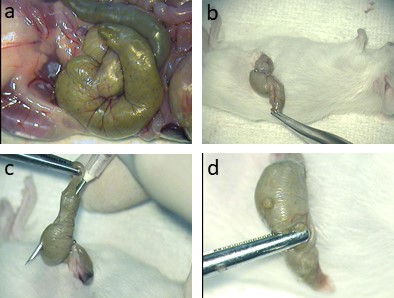
Under anesthesia, the abdomen is opened and the cecum and adjoining intestine are exposed. The cecum is tightly ligated at its base below the ileocecal valve with a steel clip. A through-and-through puncture is made using a needle, and the cecum is gently squeezed to extrude a small amount of fecal material from the puncture sites. The cecum is then returned to the peritoneal cavity and the abdomen closed. Severity is controlled by the degree of ligation and the gauge of the needle used for puncture.
Routes of Administration
Test article may be administered by oral gavage (PO), or by subcutaneous (SC), intravenous (IV), or intraperitoneal (IP) injection. Treatment typically begins after the procedure and clinical signs have developed, so that the study evaluates efficacy against established sepsis rather than prophylaxis.
Endpoints
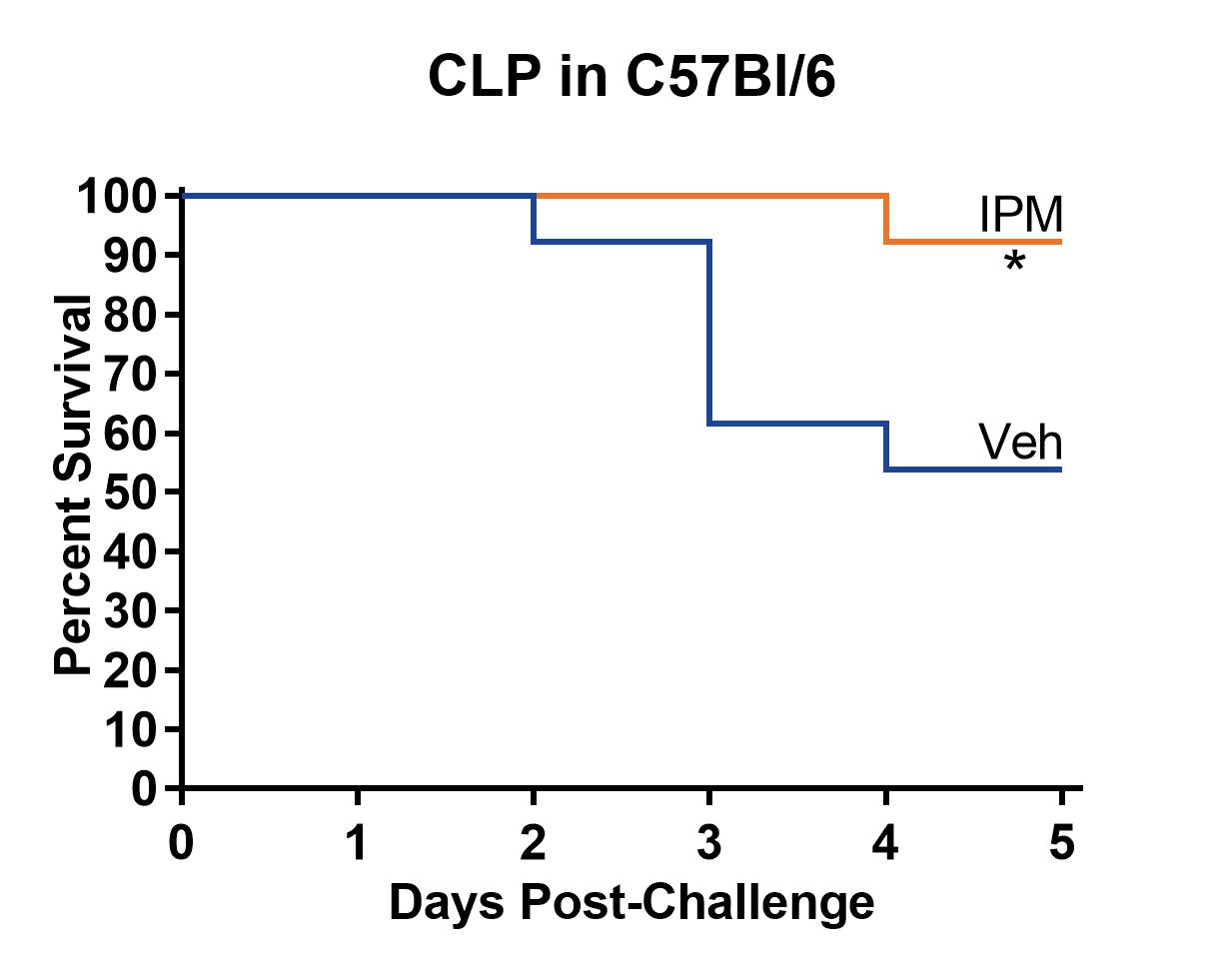
The primary endpoint is survival, tracked over the course of the study. Clinical signs of sepsis — including lethargy and diarrhea – typically appear between six and twelve hours post-procedure. Under a standard protocol, death occurs between twenty-four and sixty hours post-CLP, and survival curves generated from this window are the primary efficacy readout.
Secondary endpoints include CFU burden in blood and harvested organs, which confirms bacteremia from the gut source and allows quantitative comparison between treatment groups; and clinical scoring throughout the course of the study. Blood chemistry, cytokine panels, histopathology, and additional tissue harvests are available on request and are particularly informative in this model, where organ dysfunction and the systemic inflammatory response are central to the disease being modeled.
Sample Data