Systemic Model
Bacteremia Model
Bloodstream infection models measuring systemic bacterial burden and survival outcomes.
Bacteremia is defined as the presence of viable bacteria in the bloodstream, a compartment that is normally sterile. Organisms usually reach it from a primary focus elsewhere – the lungs, the abdomen, the urinary tract, a wound, or an indwelling line – and once seeded, they can distribute to the spleen, liver, kidneys, and other perfused tissue within hours. When the host response to that dissemination becomes dysregulated, the result is sepsis. For a therapeutic program, this makes bloodstream infection a distinct testing problem: a candidate must reach and act at multiple tissue sites at once, under a challenge that progresses quickly.
TransPharm Preclinical Solutions runs an intravenous bacteremia model in mice that measures exactly that: whether a test article reduces organism burden across disseminated tissue compartments, and whether it changes survival under a lethal or sublethal challenge.
Research Applications
This model is appropriate when the question is whether a candidate that has shown in vitro activity works against an established systemic infection. Because the challenge is delivered straight into the bloodstream, the model removes the variability introduced by a primary site and the dissemination step, which produces a cleaner and more reproducible screen. That is a deliberate trade: it is not the model to choose when the research question concerns clearance from a specific primary focus.
It suits several development questions:
- Rapid efficacy screening of novel antibacterials against a defined challenge strain
- Head-to-head comparison against a standard-of-care comparator on the same challenge
- Dose-ranging to establish the relationship between exposure and burden reduction
- Non-traditional modalities, including antibody-based therapies, where systemic distribution is the central question
- Activity against a resistant isolate, in the form of vancomycin-resistant Enterococcus faecalis (VRE)
Where the challenge organism is a fungus rather than a bacterium, the related fungemia model applies the same intravenous route and the same burden and survival readouts.
Scientific Scope
TransPharm Preclinical Solutions has validated the bacteremia model in the following Gram-positive organisms:
- Enterococcus faecalis (VRE) – ATCC 700802
- Staphylococcus aureus – ATCC 25904
- Streptococcus pneumoniae – ATCC 700674
- Streptococcus pyogenes – SP1-1 (ATCC 12384)
Several of these are characterized isolates with profiles that matter to a development program. ATCC 700802 is E. faecalis V583, recovered from the blood of a patient in St. Louis, Missouri; it is resistant to vancomycin and gentamicin, and carries the vanB resistance determinant. ATCC 700674 is S. pneumoniae S. Africa 19A-7, a blood-culture isolate with intermediate resistance to penicillin and a representative strain of the Pneumococcal Molecular Epidemiology Network. ATCC 25904 is S. aureus Newman D2C (NCTC 10833), a clumping factor-positive variant of the Newman D2 strain; the Newman lineage is methicillin-susceptible and has been used extensively in animal models of staphylococcal disease. SP1-1 is ATCC 12384.
Additional validations are available on request, and client-supplied isolates can be characterized and validated in the model before a study begins.
The bacteremia model carries the same add-on measurements available across all in vivo work at TransPharm Preclinical Solutions: pharmacokinetic profiling and PK/PD analysis, blood chemistry, additional tissue harvests, and histopathology, each available on request. All studies run in an AAALAC-accredited facility.
Study Design
Procedure
Animals are challenged with the selected pathogen by intravenous injection into the lateral tail vein. Studies are run in mice, with validation in rats available on request.
Routes of Administration
Test article may be administered by oral gavage (PO), or by subcutaneous (SC), intravenous (IV), or intraperitoneal (IP) injection, so dosing can match the route the program intends to use clinically.
Endpoints
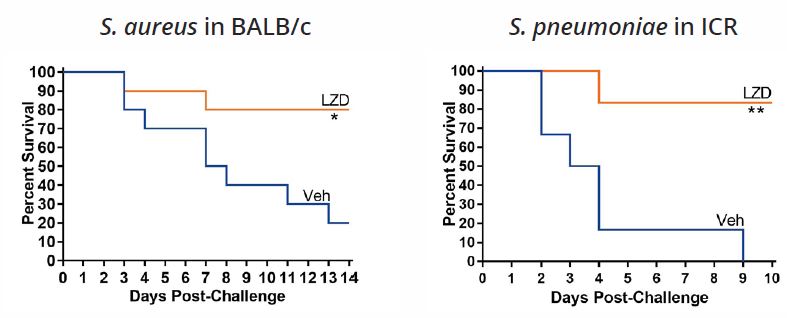
The primary readouts are survival (mortality tracking) and CFU burden in harvested organs and/or blood. Organ burden gives a quantitative, log-scale measure of treatment effect at each tissue site sampled; mortality gives the survival outcome under a lethal challenge. The two are frequently run together, since a compound can reduce burden measurably without shifting survival, and the combination distinguishes those results.
Customization
Every study parameter is configurable to the scientific question: challenge strain, host species and strain, comparator agents, and dosing schedule. Challenge inoculum can be set to a lethal dose where survival is the endpoint, or to a sublethal dose where the question is burden reduction in animals that survive to a scheduled harvest. Which tissue compartments are sampled, and at which time points, is likewise set to the program’s question rather than to a fixed panel.
Sample Data