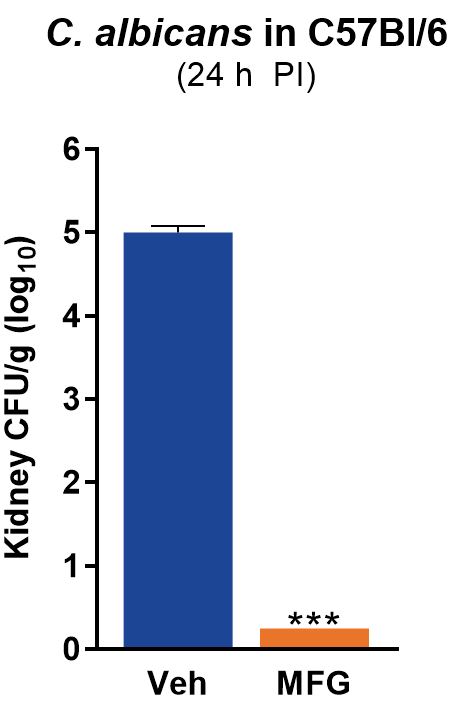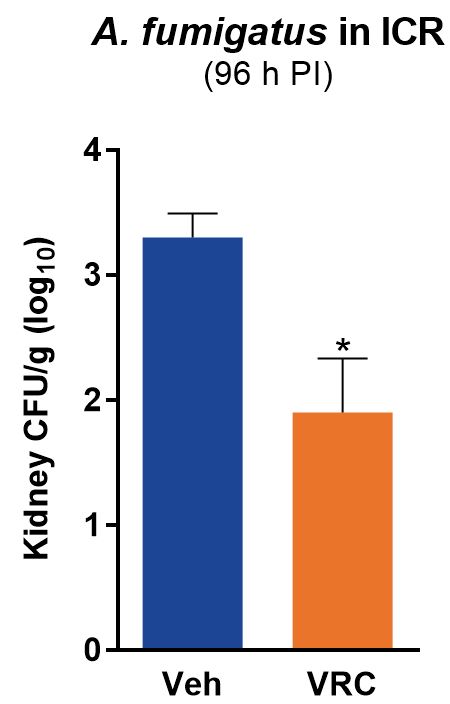
Systemic Model
Fungemia Model
Disseminated fungal infection models for evaluating antifungal compound efficacy.
Fungemia is the presence of viable fungi in the bloodstream, a compartment that is normally sterile. It arises most often in patients whose defenses are already compromised – those receiving cytotoxic chemotherapy, transplant recipients on immunosuppression, and patients with indwelling vascular catheters – and the organisms typically originate from a focus elsewhere in the body before entering the circulation. Once disseminated, they can seed the kidneys, liver, spleen, and other perfused tissue, and the host response to that dissemination may progress to sepsis.
Invasive fungal disease carries high mortality even where antifungal therapy is available, and the therapeutic options are narrower than on the antibacterial side: three main drug classes, with resistance emerging in each. That makes systemic antifungal efficacy data a gating requirement for programs in this space.
TransPharm Preclinical Solutions runs an intravenous fungemia model in mice that measures whether a test article reduces fungal burden across disseminated tissue compartments and whether it changes survival under challenge.
Research Applications
This model is appropriate when a compound has demonstrated in vitro antifungal activity and the question is whether that activity holds in an established systemic infection. Delivering the challenge directly into the bloodstream removes the variability of a primary site and the translocation step, producing a cleaner and more reproducible screen. It is not the model for questions about gut colonization or translocation as a route of dissemination, which require a different design.
It suits several development questions:
- Efficacy screening of novel antifungals against a defined challenge organism.
- Comparison against an established agent from the azole, echinocandin, or polyene classes on the same challenge.
- Dose-ranging to relate exposure to burden reduction.
- Candidates directed at resistant isolates, where the comparator is expected to fail and the study is designed around that contrast.
Fungemia is the systemic fungal option among the models at TransPharm Preclinical Solutions; where the challenge organism is a bacterium, the related bacteremia model is also available.
Scientific Scope
TransPharm Preclinical Solutions has validated the fungemia model with both a yeast and a filamentous mold:
- Aspergillus fumigatus – ATCC 13073
- Candida albicans – SC5314 (ATCC MYA-2876)
Both are well-characterized reference isolates. ATCC 13073 is A. fumigatus NIH strain B-5233, one of the most widely used isolates in murine invasive aspergillosis research and the challenge strain in published antifungal efficacy studies. SC5314 is the C. albicans reference isolate whose genome underpins the public Candida genome resources; it is a clinical specimen isolate and is notably invasive, with strong filamentation and biofilm formation relative to many other clinical isolates.
Additional validations are available on request, and client-supplied isolates can be characterized and validated in the model before a study begins.
The fungemia model carries the same add-on measurements available across all in vivo work at TransPharm Preclinical Solutions: pharmacokinetic profiling and PK/PD analysis, blood chemistry, additional tissue harvests, and histopathology, each available on request. All studies run in an AAALAC-accredited facility.
Study Design
Procedure
Animals are challenged with the selected fungus by intravenous injection into the lateral tail vein. Studies are run in mice, with validation in rats available on request. Every study parameter is configurable to the scientific question: challenge organism, host strain, comparator agents, and dosing schedule.
Routes of Administration
Test article may be administered by oral gavage (PO), or by subcutaneous (SC), intravenous (IV), or intraperitoneal (IP) injection. Route selection follows the formulation and the exposure profile the program needs to demonstrate, which is relevant here since oral bioavailability is a differentiator for several antifungal classes.
Endpoints
The primary readouts are survival (mortality tracking) and CFU burden in harvested organs and/or blood. Organ burden gives a quantitative, log-scale measure of treatment effect at each tissue site sampled; mortality gives the survival outcome under a lethal challenge. Running the two together distinguishes a compound that lowers burden measurably from one that also shifts survival. Pharmacokinetic profiling, blood chemistry, additional tissue harvests, and histology can be added to any study on request.
Sample Data