Specialty Model
Gastrointestinal Infection Model
GI infection models, including Clostridioides difficile-associated disease.
Gastrointestinal infection covers a range of distinct disease processes that share one thing: the gut as the site. Clostridioides difficile, the leading cause of healthcare-associated infectious diarrhea, causes disease through toxin-mediated destruction of the intestinal lining after antibiotics open the niche for it. Salmonella Typhimurium invades the gut epithelium and can disseminate to the bloodstream. Enterococcus strains of greatest clinical concern are the ones that colonize the gut silently under selection pressure and serve as a reservoir for both infection and resistance-gene spread.
These differences matter for study design. A model that can accommodate all of them — and that supports the unusual dosing routes gut-targeted therapies require — is a more useful tool than one built around a single pathogen type.
TransPharm Preclinical Solutions’s gastrointestinal model establishes infection in the mouse gut by oral gavage and measures colonization and disease using a broader set of endpoints than any other model on the platform.
Research Applications
This model is appropriate when the question concerns the gut as the site of infection or colonization, when the program needs oral or gut-targeted delivery, or when the endpoint most relevant to the indication is fecal burden rather than blood or organ CFU.
The model’s distinguishing features within the platform are its endpoints and its dosing routes.
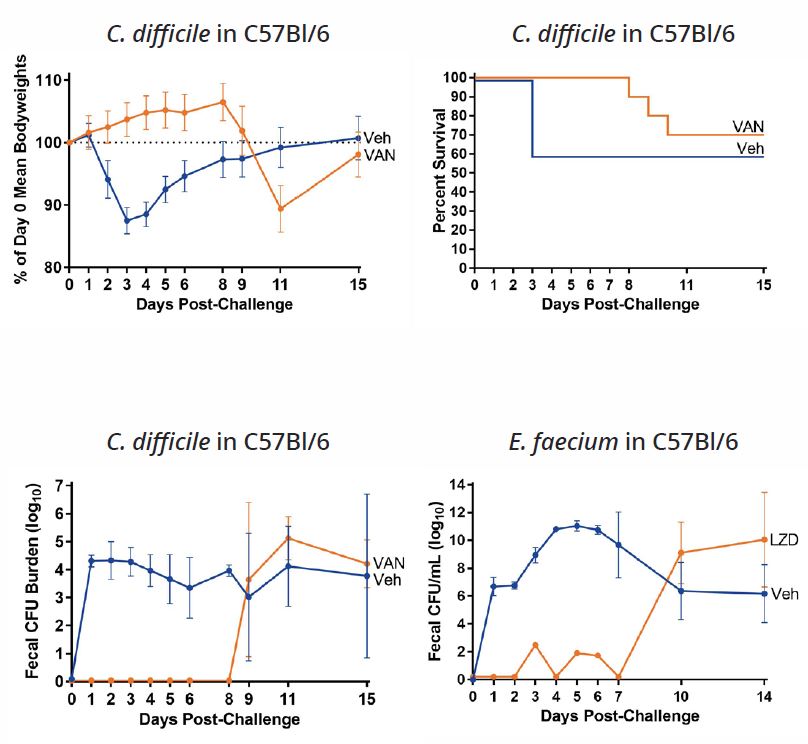
Fecal CFU burden is the primary colonization readout. It is the most clinically relevant measure for intestinal pathogens, where burden in stool reflects the colonization state more directly than organ harvest does. Combined with weight tracking and clinical observations across the course of infection, it gives a longitudinal picture of disease that a single endpoint cannot.
The dosing routes include options available nowhere else on the platform: perirectal administration for gut-targeted formulations, and delivery via diet or drinking water for long-duration treatments and compounds that need to be delivered continuously. That set supports gut-restricted agents — bacteriophage preparations, live biotherapeutic products, microbiome-protective agents, spore-targeting compounds, and next-generation narrow-spectrum antibiotics — alongside conventional systemic candidates.
Typical uses include:
- Efficacy screening of antibiotics for C. difficile infection, including candidates positioned as microbiome-sparing alternatives to metronidazole, vancomycin, or fidaxomicin.
- Anti-toxin, spore-targeting, or microbiome-restorative therapies, where a conventional CFU endpoint tells only part of the story.
- Decolonization programs targeting gut-resident VRE, where fecal burden and the effect of treatment on persistent colonization are the readout.
- Salmonellosis candidates, dosed by the oral route relevant to a foodborne pathogen.
- Any program delivering the test article orally, perirectally, or via diet or drinking water.
Scientific Scope
TransPharm Preclinical Solutions has validated the gastrointestinal model using the following pathogens:
- Clostridioides difficile – ATCC 43255 (VPI 10463)
- Enterococcus faecalis – ATCC 700221, ATCC 700802, EFS-007
- Enterococcus faecium – 03B1022
- Escherichia coli – ATCC 48395
- Salmonella enterica serovar Typhimurium – CDC 6516-60
Clostridioides difficile (formerly Clostridium difficile) is the leading cause of healthcare-associated infectious diarrhea, classified as an urgent public-health threat by the CDC. ATCC 43255 is strain VPI 10463, a toxigenic reference isolate (toxinotype 0, ribotype 087) that produces both TcdA and TcdB toxins — the exotoxins responsible for intestinal damage — and is the standard challenge strain in published C. difficile efficacy work.
CDC 6516-60 is equivalent to Salmonella Typhimurium ATCC 14028, a whole-genome-sequenced reference strain originally isolated from poultry and widely used in enteric and systemic Salmonella research.
ATCC 700802 is E. faecalis V583, a vancomycin-resistant bloodstream isolate carrying vanB, and one of the most studied vancomycin-resistant Enterococcus (VRE) strains. The two VRE-relevant isolates — 700802 and 700221 — support decolonization work directly relevant to nosocomial infection control programs.
Additional validations are available on request, and client-supplied isolates can be characterized and validated in the model before a study begins.
The gastrointestinal model carries the same add-on measurements available across all in vivo work at TransPharm Preclinical Solutions: pharmacokinetic profiling and PK/PD analysis, blood chemistry, additional tissue harvests, and histopathology, each available on request. All studies run in an AAALAC-accredited preclinical efficacy testing laboratory.
Study Design
Procedure
Animals are challenged with the selected pathogen by oral gavage, mimicking the oral-fecal route of most gastrointestinal infection. For pathogens whose establishment depends on prior disruption of the gut microbiota — including C. difficile and S. Typhimurium — animals receive an antibiotic pretreatment regimen before challenge. For the C. difficile model, this is intraperitoneal clindamycin administration the day before challenge, reproducing the antibiotic-associated niche in which C. difficile overgrows and produces toxins clinically.
Studies are run in mice. Every study parameter is configurable to the scientific question: challenge organism and strain, host strain, pretreatment regimen, comparator agents, and dosing schedule.
Routes of Administration
Test article may be administered by oral gavage (PO), perirectal (PR) administration, subcutaneous (SC), intravenous (IV), or intraperitoneal (IP) injection, or via diet or drinking water — the widest set of administration routes available across the platform. Oral and perirectal routes are the most commonly chosen for candidates whose target is the gut, where local drug concentrations matter independently of systemic exposure.
Endpoints
The primary readouts are mortality tracking, clinical observations, weight tracking, and CFU burden in feces, organs, and/or blood.
Fecal CFU is the colonization endpoint and the most informative measure for intestinal pathogens. Organ and blood burden capture dissemination beyond the gut, which is relevant for invasive organisms like Salmonella. Weight tracking and clinical observations provide a longitudinal, quantitative picture of disease severity across the study — endpoints that matter particularly for C. difficile, where toxin-driven diarrhea and dehydration are the disease, not organ-level burden alone.
Pharmacokinetic profiling, blood chemistry, additional tissue harvests, and histology can be added to any study on request.
Sample Data