Specialty Model
Soft Tissue Infection Model
Deep soft-tissue infection models across multiple anatomical sites.
Soft tissue infection involves the skin, subcutaneous tissue, fascia, and muscle. It typically begins with a break in the skin – a wound, a surgical incision, an injection site – that lets organisms into tissue that is normally sterile, and it progresses more readily in patients whose immune defenses are impaired. Skin and soft tissue infections are among the most common reasons for antibacterial treatment, and the organisms responsible increasingly include resistant strains for which the options are limited.
TransPharm Preclinical Solutions’s soft tissue model, established by intramuscular challenge of the quadriceps, is the thigh infection model familiar to antibacterial development programs. It delivers a defined inoculum into muscle and measures how far a test article lowers the organism burden there.
Research Applications
This model is appropriate when the question is whether a candidate reduces bacterial burden in infected muscle, and it is the platform of choice when the question is about exposure rather than simply about efficacy.
The thigh model is the established setting for pharmacokinetic/pharmacodynamic characterization in antibacterial development. Because the challenge is delivered into a defined, sampleable tissue compartment with a reproducible inoculum, burden reduction can be related quantitatively to drug exposure, which is what dose fractionation and exposure-response work require. TransPharm Preclinical Solutions runs those studies alongside the efficacy arm: dose fractionation, exposure-response, time course, and infected and non-infected tissue PK, including soft tissue.
A second practical feature is that challenge can be delivered to one or both quadriceps. Bilateral challenge provides two infection sites per animal, which supports tighter within-animal comparisons and reduces the number of animals a dose-ranging study requires.
Typical uses include:
- PK/PD index determination and dose fractionation, establishing whether activity is driven by time above MIC, peak-to-MIC ratio, or total exposure
- Efficacy screening against a defined challenge strain, with a quantitative muscle burden readout
- Comparison against standard of care on the same challenge
- Activity against resistant isolates, including MRSA, vancomycin-resistant Enterococcus, and carbapenemase-producing Enterobacterales
Soft tissue is the muscle-compartment model at TransPharm Preclinical Solutions. Where infection is confined to the skin, the dermal models apply; where the question concerns bone, the osteomyelitis model is also available.
Scientific Scope
TransPharm Preclinical Solutions has validated the soft tissue model across the following pathogens:
- Acinetobacter baumannii – ATCC 17961
- Enterococcus faecalis – ATCC 700802, EFS-007
- Escherichia coli – ATCC 25922, ATCC BAA-457
- Klebsiella pneumoniae – ATCC BAA-2146
- Staphylococcus aureus – ATCC 29213, ATCC BAA-1717 (MRSA), USA300 (MRSA)
- Streptococcus pyogenes – ATCC 19615, SPI-3541
The roster is built around resistance phenotypes that matter to a development program. ATCC BAA-2146 is a New Delhi metallo-β-lactamase (NDM-1) producing K. pneumoniae, confirmed KPC-negative and NDM-positive by PCR, isolated from the urine of a US patient who had recently received medical care in India – a carbapenemase producer of exactly the kind that sits in the critical tier of the WHO 2024 Bacterial Priority Pathogens List. ATCC 700802 is E. faecalis V583, a vancomycin- and gentamicin-resistant bloodstream isolate carrying vanB. MRSA is represented by two isolates.
The roster also pairs resistant isolates with their susceptible reference counterparts. ATCC 25922 (E. coli) and ATCC 29213 (S. aureus) are the standard susceptibility-testing quality control strains, which means a program can run its in vivo challenge in the same isolates it uses for MIC quality control and compare potency and efficacy without a strain change in between.
Additional validations are available on request, and client-supplied isolates can be characterized and validated in the model before a study begins.
The soft tissue model carries the same add-on measurements available across all in vivo work at TransPharm Preclinical Solutions: pharmacokinetic profiling and PK/PD analysis, blood chemistry, additional tissue harvests, and histopathology, each available on request. All studies run in an AAALAC-accredited facility.
Study Design
Procedure
Animals are challenged with the selected pathogen by intramuscular (IM) injection into one or both quadriceps muscles. Studies are run in mice. Every study parameter is configurable to the scientific question: challenge strain, host strain, comparator agents, and dosing schedule.
Routes of Administration
Test article may be administered by oral gavage (PO), or by subcutaneous (SC), intravenous (IV), or intraperitoneal (IP) injection, so dosing can match the route the program intends to use clinically.
Endpoints
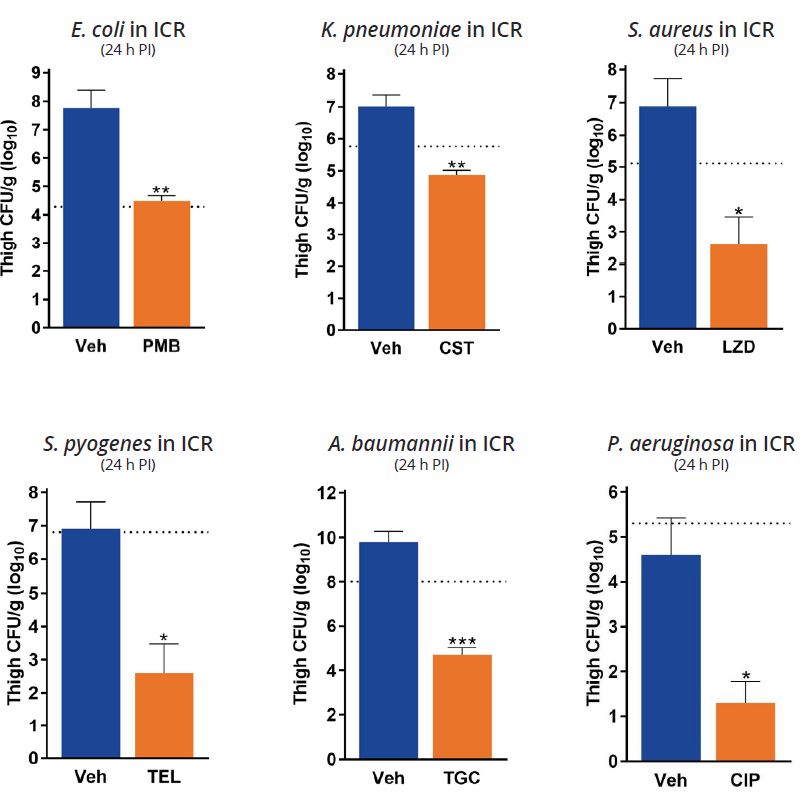
The primary readout is CFU burden in harvested muscle tissue, giving a quantitative, log-scale measure of treatment effect at the infection site. Because the challenge is in a defined, sampleable compartment, the burden readout is precise and reproducible — which is exactly what exposure-response and dose-fractionation studies require. Blood and additional organ sampling are available where systemic dissemination is part of the question. Survival can be tracked in a lethal-dose protocol but is not the primary endpoint in the standard model. Pharmacokinetic profiling — including soft tissue drug concentrations alongside the muscle burden endpoint — blood chemistry, additional tissue harvests, and histology can be added to any study on request.
Sample Data