Skin & Wound Model
Dermal Infection – Abrasion Model
Surface skin infection models for evaluating topical antimicrobials.
The skin is the site where herpes simplex virus establishes infection and the site where it returns. After a primary cutaneous infection, HSV travels from the skin into sensory nerve endings, reaches the dorsal root ganglia, and can then spread back outward along those nerves to produce lesions in a belt-like distribution. That nerve-mediated route is what distinguishes cutaneous herpes disease from an ordinary skin infection, and it is what an antiviral candidate aimed at acute cutaneous disease has to interrupt.
TransPharm Preclinical Solutions’s abrasion model establishes cutaneous infection through an abraded epidermal barrier and follows that spread as it develops.
Research Applications
This model is appropriate when the question is whether a candidate limits the severity and extent of cutaneous viral disease. It suits several development questions:
- Topical antivirals for cutaneous herpes disease, where the exposure that matters is at the skin rather than in plasma
- Systemic antivirals dosed by the oral or parenteral route the program will ultimately use
- Comparison of topical against systemic delivery of the same candidate in the same model
- Candidates positioned against drug-resistant infection, where a resistant challenge isolate and a nucleoside-analogue comparator can be run together and the comparator is expected to fail
This model is the superficial-abrasion option among the dermal models at TransPharm Preclinical Solutions. Where a full-thickness wound is needed, the deep wound model applies; the tape stripping model offers a gentler barrier disruption, and the intradermal model places the challenge directly in the dermis.
Scientific Scope
TransPharm Preclinical Solutions has validated the abrasion model with herpes simplex virus 1:
- Herpes Simplex Virus 1 – H129C
HSV-1 is among the most prevalent pathogens in the world, carried for life by roughly two thirds of people under fifty. Most infection in immunocompetent people is mild, but in the immunocompromised, in neonates, and at immune-privileged sites it causes severe disease. There is no cure and no licensed vaccine, which leaves antiviral therapy as the only tool.
Additional validations are available on request. Characterized HSV-1 isolates, including resistant strains, can be sourced and validated to a program’s specifications, and the model also supports bacterial challenge where a superficial abrasion is the appropriate route.
The abrasion model carries the same add-on measurements available across all in vivo work at TransPharm Preclinical Solutions: pharmacokinetic profiling and PK/PD analysis, blood chemistry, additional tissue harvests, and histopathology, each available on request. All studies run in an AAALAC-accredited facility.
Study Design
Procedure
The dorsal skin is abraded with sandpaper to remove the outermost epidermal layer, and animals receive a topical inoculation at the abraded site. Studies are run in mice. Every study parameter is configurable to the scientific question: challenge strain, host strain, comparator agents, and dosing schedule.
Routes of Administration
Test article can be given topically or systemically – topical application, oral gavage (PO), subcutaneous (SC), intraperitoneal (IP), or intravenous (IV) – supporting both topically and systemically delivered candidates.
Endpoints
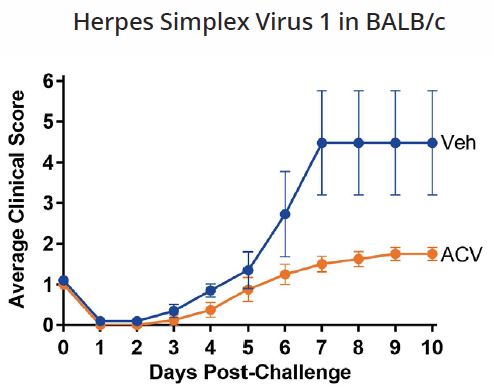
For HSV infection, the primary readout is clinical scoring of zosteriform spread, assessed by trained observers on a standardized scale that captures the severity and distribution of skin lesions. Histopathology is available to confirm tissue-level findings.
For bacterial infection, the readout is CFU burden in harvested skin.
Pharmacokinetic profiling, blood chemistry, additional tissue harvests, and histology can be added to any study on request.
Sample Data