Skin & Wound Model
Tape-Stripping Model
Compromised skin-barrier infection models for topical therapy evaluation.
Intact skin resists colonization. When the barrier is compromised – by eczema, by mechanical damage, by repeated washing or friction – organisms that typically sit harmlessly on healthy skin may be able to establish infection. This is the mechanism behind a large share of clinical skin infection, and it is a setting in which a compound’s ability to reach organisms in partially disrupted tissue, rather than its potency in broth, determines whether it works.
TransPharm Preclinical Solutions’s tape stripping model reproduces that compromised barrier without wounding the skin, infects it with a defined inoculum, and measures how far a test article lowers the burden there.
Research Applications
This model is appropriate when the question is whether a candidate reduces burden in skin whose barrier is impaired but whose structure is otherwise intact. Repeated application and removal of surgical tape disrupts the epidermal layer progressively and without cutting, so the skin architecture beneath remains in place. That makes it the gentlest of the barrier-disrupting dermal models and the closest analogue to the compromised-barrier skin seen clinically.
It suits several development questions:
- Topical antimicrobials and antifungals, where the exposure that matters is at the skin surface and in the superficial layers rather than in plasma
- Systemic agents dosed by the oral or parenteral route the program intends to use clinically
- Comparison of topical against systemic delivery of the same candidate in the same model
- Activity against resistant skin pathogens, including methicillin-resistant Staphylococcus aureus (MRSA)
- Antifungal programs targeting cutaneous Candida, which the other dermal models at TransPharm Preclinical Solutions do not currently support
Tape stripping is the superficial, non-wounding option among the dermal models at TransPharm Preclinical Solutions. Where a full-thickness wound is needed, the deep wound model applies; the scratch model uses sandpaper abrasion and supports cutaneous antiviral work, and the intradermal model places the challenge directly in the dermis.
Scientific Scope
TransPharm Preclinical Solutions has validated the tape stripping model with both a bacterium and a yeast:
- Staphylococcus aureus (MRSA) – USA300
- Candida albicans – SC5314 (ATCC MYA-2876)
The pairing reflects what actually colonizes damaged skin. USA300 is the community-associated MRSA lineage and the dominant cause of skin and soft tissue infection in that setting; MRSA appears in the high-priority tier of the WHO 2024 Bacterial Priority Pathogens List. SC5314 is the C. albicans reference isolate whose genome underpins the public Candida genome resources, and it is notably invasive with strong filamentation relative to many other clinical isolates.
Having a bacterial and a fungal validation in the same model is useful beyond covering two indications. Compromised-barrier skin is frequently colonized by both, and a program working in that space can run parallel arms on a single platform rather than validating a second model.
Additional validations are available on request, and client-supplied isolates can be characterized and validated in the model before a study begins.
The tape stripping model carries the same add-on measurements available across all in vivo work at TransPharm Preclinical Solutions: pharmacokinetic profiling and PK/PD analysis, blood chemistry, additional tissue harvests, and histopathology, each available on request. All studies run in an AAALAC-accredited facility.
Study Design
Procedure
Surgical tape is repeatedly applied to and removed from an area on the back to disrupt the epidermal layer of skin, and animals are then challenged with a topical inoculation at that site. Studies are run in mice. Every study parameter is configurable to the scientific question: challenge organism, host strain, comparator agents, and dosing schedule.
Routes of Administration
Test article can be given topically or systemically – topical application, oral gavage (PO), subcutaneous (SC), intraperitoneal (IP), or intravenous (IV) – so dosing can match the route the program intends to use clinically.
Endpoint
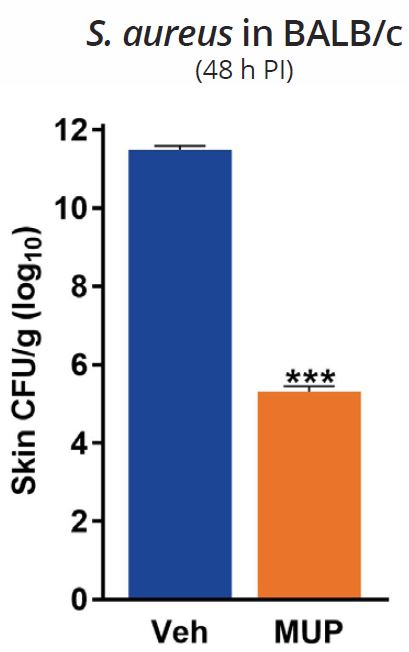
The primary readout is burden in harvested skin, reported as CFU per gram. Pharmacokinetic profiling, blood chemistry, additional tissue harvests, and histology can be added to any study on request.
Sample Data