Skin & Wound Model
Deep Wound Infection Model
Wound infection models assessing efficacy in soft-tissue and surgical-site infection.
Wound infections – from trauma, surgery, or a chronic ulcer that has broken down – are a common route by which serious skin and soft-tissue infections can occur. The wound bed is poorly perfused, frequently contaminated with more than one organism, and a common reservoir for drug-resistant pathogens. This means a compound that clears an organism in broth or in a simple systemic challenge can still fail to reduce burden in infected tissue.
TransPharm Preclinical Solutions’s deep wound infection model establishes a reproducible full-thickness wound, infects it with a defined inoculum, and measures how far a test article lowers the bacterial burden in the wound itself.
Research Applications
This model is appropriate when the question is whether a candidate reduces bacterial burden in an established, full-thickness wound. The wound is inoculated directly; the endpoint is the number of viable bacteria recovered from the wound tissue, so the readout reflects how much active drug actually reaches the site of infection. This variable matters most for topical programs. Topical efficacy is not guaranteed by in vitro potency, because the drug still has to penetrate exudate and devitalized tissue to reach organisms in the wound bed.
The full-thickness biopsy-punch wound produces a defined, repeatable lesion and a fixed starting inoculum, which lets treatment groups be compared on a quantitative burden endpoint rather than a subjective wound score. It suits several development questions:
- Topical antimicrobials and wound-directed formulations, where the exposure that matters is at the wound surface rather than in plasma.
- Systemic agents for complicated skin and soft-tissue infection, dosed by the oral or parenteral route the program will ultimately use.
- Comparison of a candidate against a comparator or standard of care in the same wound.
- Activity against resistant skin pathogens, including methicillin-resistant Staphylococcus aureus (MRSA).
Because both topical and systemic routes are established for this model, it is a practical choice for programs that need to compare delivery routes or support a topical indication – something many efficacy models are not set up to do. Deep wound is the full-thickness option among the dermal models at TransPharm Preclinical Solutions; where a more superficial challenge is needed, related intradermal, scratch, and tape-stripping models are also available.
Scientific Scope
TransPharm Preclinical Solutions has validated the deep wound model with both Gram-negative and Gram-positive skin pathogens:
- Acinetobacter baumannii – ATCC 17961
- Staphylococcus aureus (MRSA) – USA300
Both of these organisms are on the WHO 2024 Bacterial Priority Pathogens List – carbapenem-resistant A. baumannii in the critical tier and MRSA in the high tier – and are most often implicated in complicated wound infection. The USA300 arm provides a defined MRSA challenge. A resistant A. baumannii isolate can be validated on request where a program needs a carbapenem-resistant target. Other challenge strains can be characterized and validated in the model before a study begins.
The deep wound model carries the same add-on measurements available across all in vivo work at TransPharm Preclinical Solutions: pharmacokinetic profiling and PK-PD analysis, blood chemistry, additional tissue harvests, and histopathology, each available on request. All studies run in an AAALAC-accredited facility.
Study Design
Procedure
A 6 mm biopsy punch creates a full-thickness wound over the dorsal thoracic area, and a broth culture of the challenge organism is inoculated directly into the wound bed. Studies are run in mice, with validation in rats available on request.
Routes of Administration
Test article can be given topically or systemically – topical application, oral gavage (PO), subcutaneous (SC), intraperitoneal (IP), or intravenous (IV) – so dosing can match the route the program intends to use clinically.
Endpoint
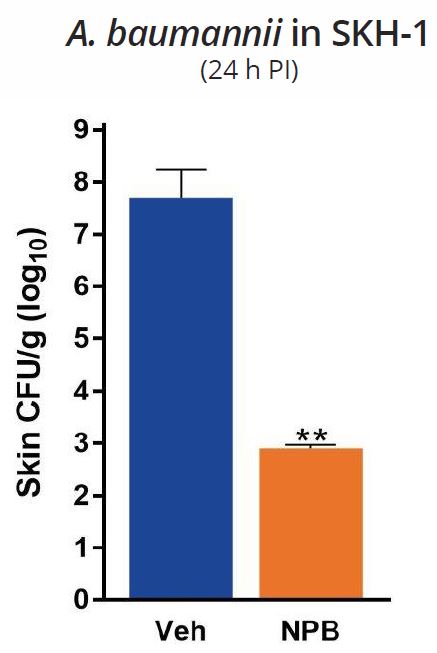
The primary readout is bacterial burden in the wound, reported as CFU per gram of harvested skin. Pharmacokinetic profiling, blood chemistry, additional tissue harvests, and histology can be added to any study on request.
Sample Data